
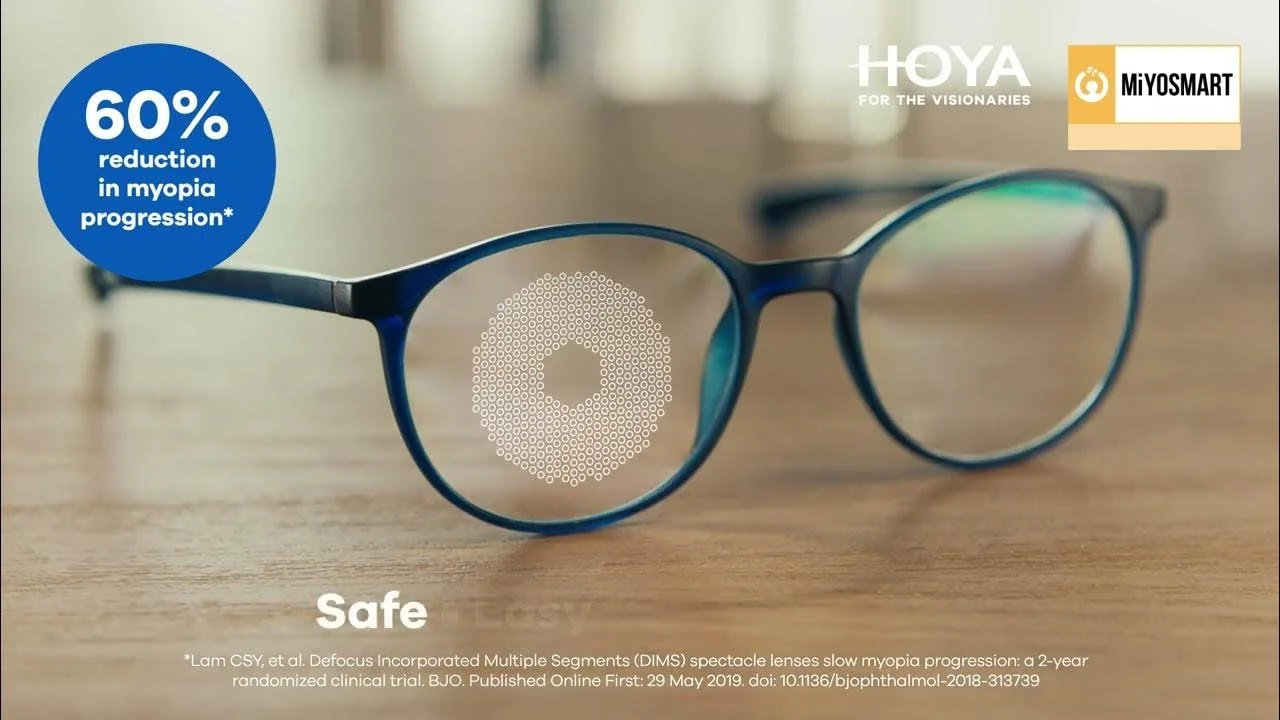
Myopia Control Glasses: Proven Protection — When Fitted Right
MiyoSmart lenses can slow your child's short-sightedness by up to 60%. But the technology only works when fitted with precision. That's where we come in.
ABOUT MYOPIA CONTROL GLASSESMore Than Regular Nearsighted Glasses
Standard single-vision eyeglasses correct your child's vision but do nothing to slow the progression of myopia. Each year, the prescription gets stronger.
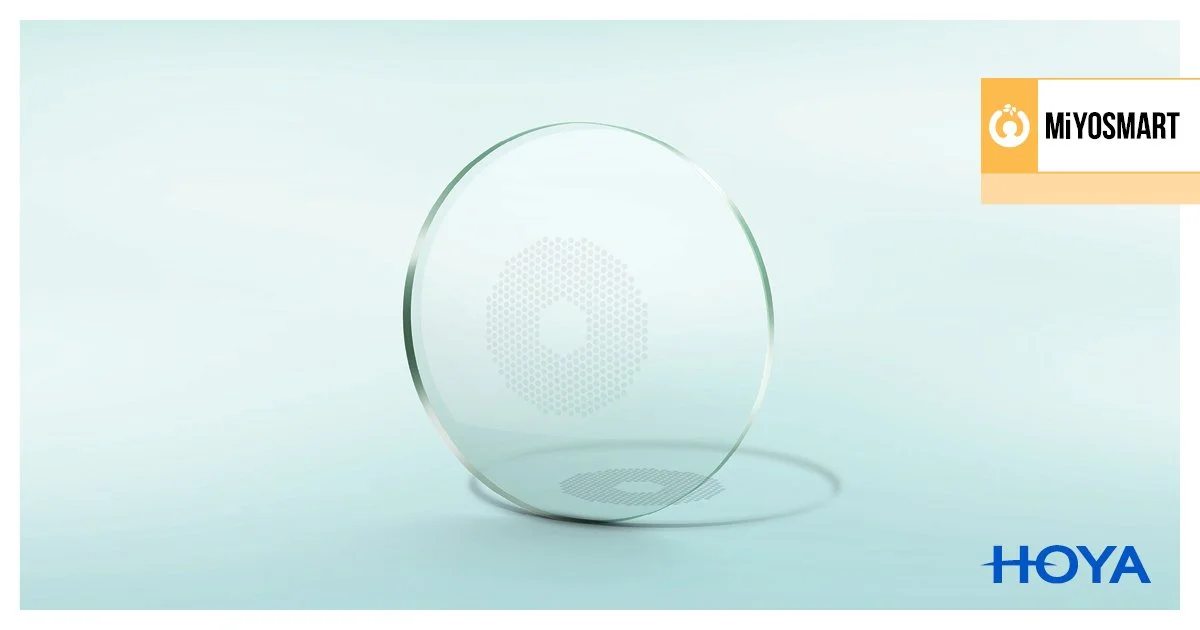
MiyoSmart lenses by Hoya use patented D.I.M.S. technology — hundreds of tiny defocus segments built into the lens surface. These create controlled myopic defocus in the peripheral retina, reducing the signals that drive eye elongation.
The result: clear, comfortable vision with the added benefit of slowing myopia progression by up to 60%. MiyoSmart myopia glasses look identical to regular eyeglasses — but they're actively protecting your child's eyes.
We also fit Stellest lenses by Essilor (H.A.L.T. technology) with comparable clinical results. We'll recommend the best myopia eyeglasses for your child.
What Can Go Wrong With a Poor Fit
Wrong Frame Size or Shape
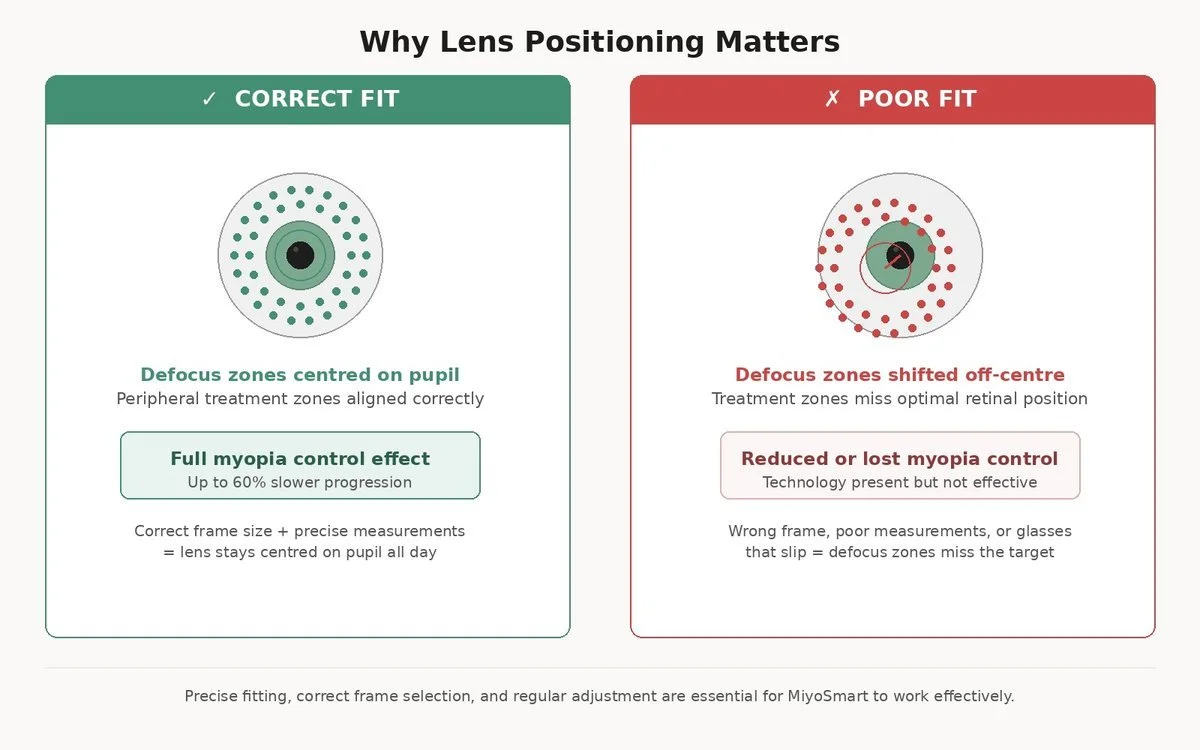
If the frame is too large, too small, or the wrong shape, the optical centre won't align with your child's pupils. The defocus segments end up in the wrong position.
Incorrect Pupil Measurements
Even 1–2mm of error in pupil distance or height can shift the defocus zone away from its optimal position. Precision digital measurement is essential.
Poor Frame Fit on Face
Glasses that slide down the nose, tilt, or sit too far from the eyes change the lens alignment with every movement. The defocus zones need to stay centred and stable.
Inadequate Frame Adjustment
MiyoSmart frames need precise adjustment — the lens position relative to the eye must remain consistent. A loose or generic adjustment undermines the technology.
This is the part many parents don't realise — and the reason not all MiyoSmart wearers get the same results.
MiyoSmart lenses contain a central correction zone surrounded by hundreds of tiny defocus segments. These segments are what slow myopia progression. But if the lens isn't positioned correctly in front of the eye, the defocus zones don't align with the retina — and the myopia control effect is reduced or lost entirely.
This means the fitting process isn't just about comfort and clear vision. It directly determines whether your child's myopia glasses actually slow their short-sightedness.
The Technology Only Works When Fitted Correctly
Our Fitting Process — Why It Matters
Every step is designed to ensure the defocus zones sit exactly where they need to be.
Comprehensive Myopia Assessment
Full eye examination including refraction, axial length measurement, and progression rate assessment. This determines whether MiyoSmart is the right option and establishes a baseline for monitoring.
Frame Selection — Not Just Any Frame
We select frames specifically designed to hold MiyoSmart lenses correctly. We use Tomato Glasses — purpose-built children's frames with adjustable nose pads, flexible temples, and secure fit features that keep the lenses precisely positioned throughout the day. Regular children's frames often slip, tilt, or sit incorrectly, which undermines the myopia control effect.
Precision Digital Measurements
We capture exact pupil distance and height within the frame using digital measurement tools — taken with the chosen frame on your child's face, in their natural head position. Not estimated or measured from a chart. Even 1–2mm matters.
Lens Centration Verification
When the glasses arrive, we don't just hand them over. We verify that the optical centres align precisely with your child's pupils. If anything is off, we adjust or re-order.
Frame Adjustment & Education
The glasses are carefully adjusted for correct nose pad position, temple length, tilt, and vertex distance. We also show parents what to look for — signs the glasses are slipping, sitting unevenly, or need readjustment.
Compliance: Why Wearing Time Matters
Even with a perfect fit, MiyoSmart lenses only work when they're being worn. Research shows a clear relationship between consistent wear and better outcomes.
The clinical trials that demonstrated 60% slower myopia progression required full-time wear — defined as constantly wearing the glasses except when sleeping or showering. Studies show children who wore their MiyoSmart lenses consistently averaged around 12 hours of daily wear.
Children who wear their glasses only part-time — removing them for sport, at home, or on weekends — will see a reduced myopia control benefit. This is why we discuss compliance openly with every family. It's not just about having the glasses — it's about wearing them consistently.
How We Support Compliance
Comfortable, Well-Fitting Frames
If glasses are uncomfortable, children take them off. Proper frame selection and adjustment with Tomato Glasses is the foundation of good compliance.
Lenses That Look Normal
MiyoSmart myopia control glasses don't look different from regular eyeglasses. There's no visual stigma — friends and classmates can't tell.
Regular Check-Ins
At each review, we discuss wearing patterns and troubleshoot barriers. If your child isn't wearing them enough, we need to understand why.
Backup Strategies
For children who struggle with full-time wear, we may combine MiyoSmart with low-dose atropine to maximise control even with less-than-perfect compliance.
One of Australia's First MiyoSmart Optometrists
Mark was one of the first Australian optometrists to fit MiyoSmart lenses — working with the technology before it was widely available on the market. This early experience gave him a deep understanding of the lens design, the fitting requirements, and the real-world clinical performance that most practitioners have only read about.
That hands-on experience means he understands not just how to fit myopia control glasses, but why each step in the fitting process matters. He's seen what happens when MiyoSmart lenses are fitted well — and what happens when they're not.
With hundreds of MiyoSmart fittings completed since launch, Mark has the depth of experience needed to optimise every pair of myopia eyeglasses for your child.

Our MiyoSmart Packages
Precision fitting is what makes myopia control glasses actually work — and it's all included.
Every Package Includes — For 12 Months:
- Comprehensive myopia assessment and axial length measurement
- Expert frame selection from our Tomato Glasses range
- Precision digital measurements for exact lens centration
- Lens centration verification at collection
- Frame adjustment and compliance education
- All review visits for 12 months
- Ongoing axial length monitoring to track progression
- 12-month lens warranty for significant prescription changes (-0.75D and over)
Because kids grow — and their eyes can change too.
Our packages include lens replacement if your child's prescription changes significantly within the first 12 months. No extra cost.
Why does the fitting process matter?
MiyoSmart lenses fitted without precision measurements may not deliver the myopia control your child needs. The same lenses fitted correctly deliver up to 60% slower progression. The difference isn't the lens — it's the fitting.
How Do Myopia Control Glasses Compare?
Every treatment has strengths. The right choice depends on your child's needs.
| Treatment | Myopia Slowing | How It's Used | Best For |
|---|---|---|---|
| MiyoSmart / Stellest Glasses | Up to 60–67% | Daytime glasses | Younger children, simplicity, first-time wearers |
| Ortho-K | Up to 60% | Night lenses only | Complete daytime freedom, swimmers, sport |
| MiSight | Up to 59% | Daily disposable lenses | Active kids preferring contacts over glasses |
| Low-Dose Atropine | Up to 50% | One drop at bedtime | Usually combined with another treatment |
Many families use MiyoSmart as their primary treatment and add low-dose atropine for enhanced control. Glasses also work well as a backup on days when Ortho-K or MiSight lenses aren't worn.
Frequently Asked Questions
What age are myopia control glasses suitable for?
From around age 4 onwards. Particularly popular for younger children who aren't ready for contact lenses. MiyoSmart is the simplest myopia control option available.
Do they look different from normal glasses?
No — MiyoSmart lenses look and feel identical to regular glasses. Your child and their friends won't notice any difference.
Why does fitting matter so much?
The defocus zones must align precisely with your child's pupils. Poor frame selection or inaccurate measurements can significantly reduce the myopia control effect.
What are Tomato Glasses?
Purpose-built children's frames with adjustable nose pads and flexible temples. They keep MiyoSmart lenses positioned correctly — critical for effectiveness. Not all frames work well with myopia control lenses.
How many hours a day should they wear them?
The clinical trials showing 60% slower progression required full-time wear — all waking hours. Research shows children averaged about 12 hours per day. Consistent compliance is key.
MiyoSmart or Stellest — which is better?
Both are clinically proven. We predominantly fit MiyoSmart due to our deep experience with the lens, but Stellest is also an excellent option. We'll recommend the best choice for your child.
What if my child's prescription changes?
Our packages include a 12-month warranty for significant changes (-0.75D and over) — new lenses at no additional cost.
Can they combine with other treatments?
Yes. MiyoSmart pairs well with low-dose atropine. They also work as a backup on days when Ortho-K or MiSight lenses aren't worn.
What if my child won't wear them full-time?
We discuss compliance openly. If full-time wear is a challenge, we can add low-dose atropine to maximise the benefit even with imperfect wearing time.
How often are check-ups?
Every 6 months for progression monitoring. All review visits are included in your package for the first 12 months.
Why Choose Concord Eyecare for MiyoSmart?
Early Australian Adopter
Mark was one of the first Australian optometrists to fit MiyoSmart — deep firsthand understanding of the lens design and fitting requirements.
Precision Fitting Focus
Digital measurements, verified centration, purpose-built Tomato Glasses frames. We don't compromise on the fitting process — it's what makes myopia control glasses actually work.
Prescription Warranty
Kids' eyes change. Lens replacement for significant prescription changes within the first 12 months — no extra cost.
Find Out if MiyoSmart is Right for Your Child
Book an assessment with Dr Mark Joung, Dr Nikki Peng or Dr Vivian Li. We'll evaluate your child's myopia, assess suitability, and ensure the fitting is done right from day one.